How AI Voice Agents Actually Work: Speech-to-Text, Brains and Voices, Explained Simply
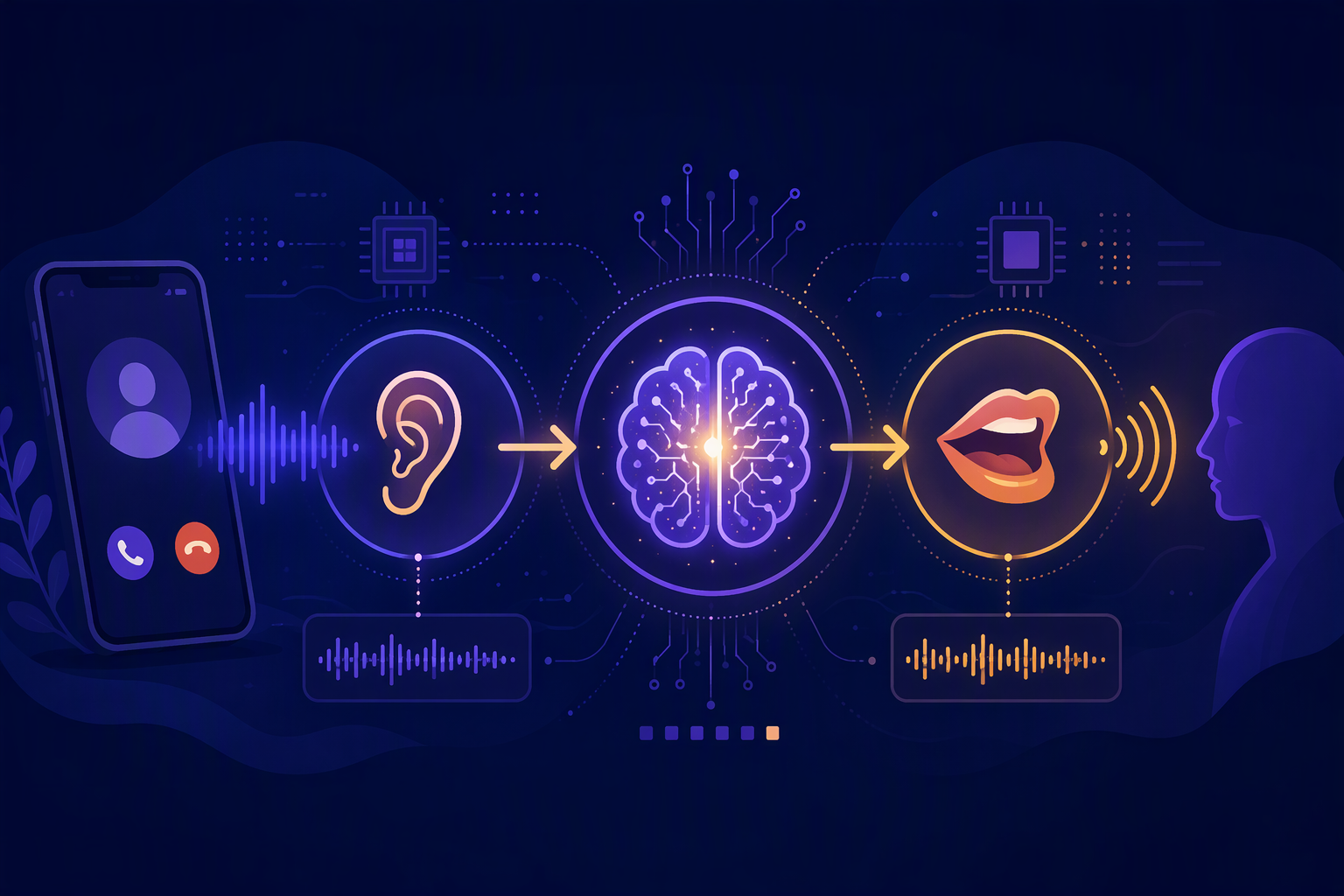
No jargon. An AI voice agent does three jobs — listening, thinking, speaking — hundreds of times a minute. Here is how each one works, why speed is everything, and the questions to ask any provider.
# How AI Voice Agents Actually Work: Speech-to-Text, Brains and Voices, Explained Simply
It feels like magic on the phone. It is actually three jobs done very fast.
When you call a business and a friendly voice answers instantly — knows the prices, books the appointment, switches to Kiswahili when you do — it feels like talking to a person. Underneath, an AI voice agent is doing three distinct jobs, hundreds of times per minute, and doing them fast enough that the conversation feels natural.
You do not need to be technical to understand how it works. Here is the whole picture in plain language.
Job 1: Listening — turning your voice into text
When you speak on the phone, your voice arrives as an audio signal. The first component, called a speech-to-text or transcription model, converts that audio into written words in real time. Modern transcription is remarkably robust: it handles mobile phone audio, background noise, accents and code-switching — a caller moving between English and Sheng mid-sentence is transcribed as the words actually spoken.
Speed matters enormously here. If transcription lags, the agent responds late and the conversation feels broken. Today's best systems transcribe within a fraction of a second.
Job 2: Thinking — deciding what to say and do
The transcribed words go to the brain: a large language model, the same family of technology behind ChatGPT. But this is not a chatbot pasted onto a phone line. The model has been given a carefully written briefing — the business's prices, services, policies, opening hours, and the rules of the conversation: greet politely, answer what you know, capture the caller's name and number, book the appointment, and hand over to a human when the question goes beyond your knowledge.
The model reads the full conversation history plus this briefing and decides, in about a second, what to say next and what action to take — create the booking, send the confirmation SMS, log the enquiry. This is why a good agent does not just talk; it finishes tasks during the call.
Job 3: Speaking — turning the reply back into voice
Finally, a text-to-speech voice model converts the reply into natural-sounding speech and streams it down the phone line. Modern voices are a world away from the robotic text-to-speech of a decade ago — they have natural intonation, pause appropriately, and come in many languages and accents, including voices tuned for specific markets.
Why speed is the whole game
Add up the three stages and the agent must respond in roughly one to two seconds to feel natural. Every component is therefore optimised for latency: transcription that keeps up with live speech, a brain that answers quickly, a voice that starts speaking the moment the first words are ready. When any one of the three is slow, callers notice the pause — and blame the whole experience.
This is also why the newest "speech-to-speech" models, which combine listening and speaking into a single system, are such a big deal: they cut the number of steps, which cuts the delay.
Where the business knowledge comes from
Here is the part most people miss: the agent's quality comes less from the AI than from the briefing it is given. Two agents can run on the same underlying technology and perform completely differently, because one was given a thorough, well-organised knowledge of the business — real prices, real policies, real answers — and the other was given a paragraph of generic marketing text.
Building the agent is the easy part. Feeding it the right knowledge, connecting it to the calendar and the phone line, and testing it with real calls is what separates a demo from a receptionist.
What this means if you are evaluating voice AI for your business
When a provider demos an agent for you, the right questions are now simple:
- How fast does it respond, end to end?
- How well does it understand my customers' accents and languages?
- Where does its knowledge come from, and how do I update it?
- What does it do when it does not know an answer — and how do I get those messages?
- How reliable is the phone connection to my customers?
The technology inside is no longer the mystery it was. The difference between vendors today is not whether they have the three components — everyone does. It is how well those components are tuned, connected and briefed for your phones and your callers.
That is the part we obsess over at WeDial AI: not just building agents, but making them genuinely good at answering your business's calls — in your market's languages, on your market's phone networks, every hour of every day.
One practical AI tip for your business, every week
The WeDial Weekly — every Sunday morning. No spam, unsubscribe anytime.
About the author
Peter Wafula is the founder of WeDial AI — a Nairobi-built platform of AI voice and chat agents that answer every call for businesses in 52 languages. He writes from hands-on experience deploying AI agents for real businesses.
Never miss another customer call
See how WeDial AI answers, qualifies, and books for your business — 24/7, in English and Swahili.
Get Free Demo CreditsRelated articles
The 7 Call Flows Every Business Should Automate First
Missed call recovery, after-hours answering, booking, lead qualification, FAQ deflection, order status, and review requests: the seven…
How to Calculate the ROI of an AI Receptionist (With a Simple Formula)
Most AI receptionist pitches are adjectives. This one is arithmetic: the exact formula, a worked example in KES, and a break-even test you…
The Big Story in AI Voice This Week — and What It Means for Your Business (Oct 14, 2026)
xAI just launched a no-code voice agent builder, ElevenLabs doubled its valuation to $22B, and voice AI startups pulled in $1.13B in three…