How Kenyan Clinics Can Cut Patient No-Shows by 40% with AI Reminders
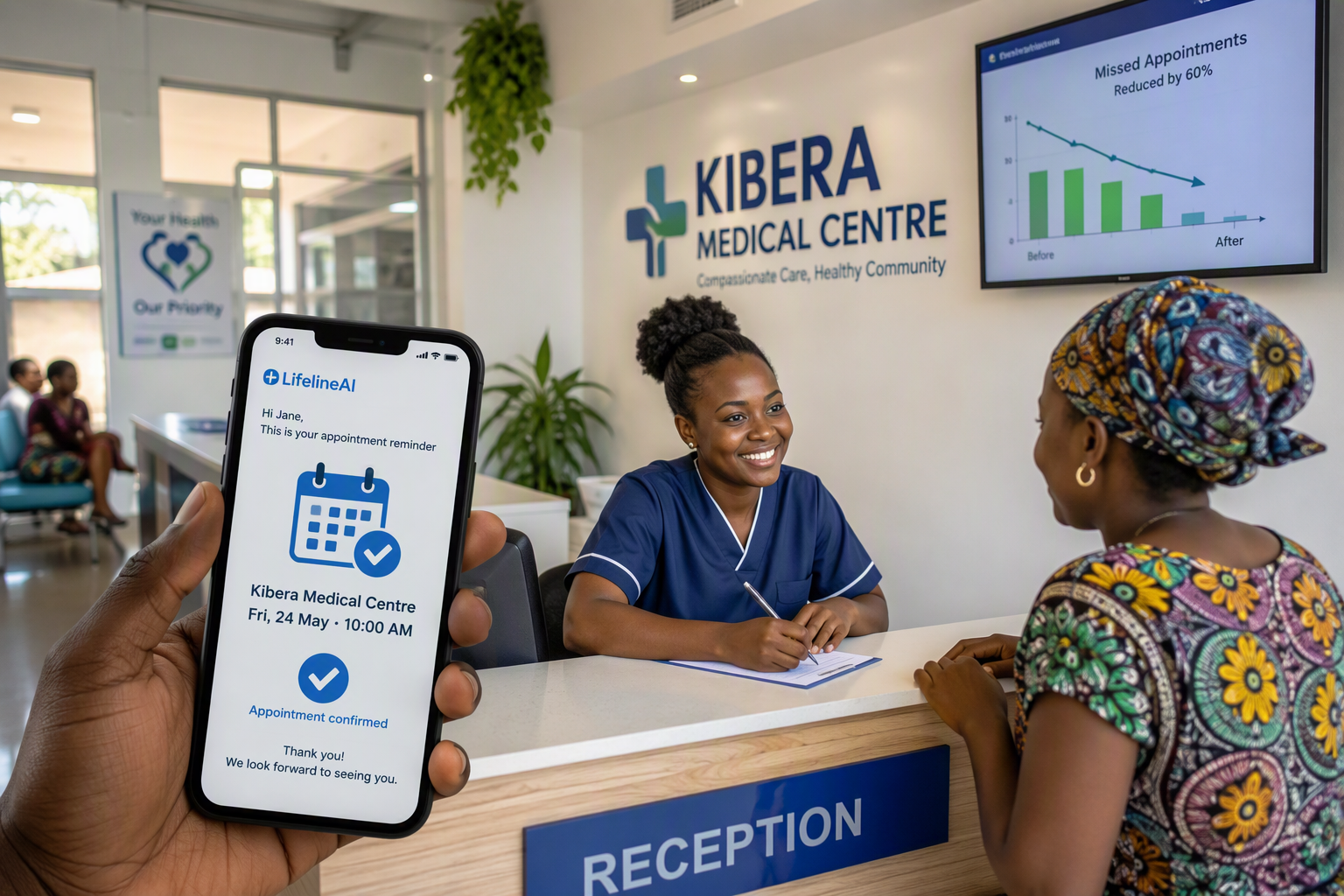
Kenyan clinics lose millions a year to empty appointment slots. Here's how AI voice and WhatsApp reminders confirm, reschedule, and backfill your diary automatically — with real Nairobi numbers.
It's 8:55 on a Monday morning at a dental clinic in Westlands. Dr. Njeri has sterilised her instruments, reviewed the X-rays, and prepped the chair for a 9 AM root canal — a KES 25,000 procedure booked three weeks ago.
9:15. No patient. The receptionist calls. The phone rings out. A WhatsApp message goes blue-ticked with no reply. By 9:30, the slot is dead — and so is the revenue. The hygienist's time, the nurse on shift, the rent on the surgery room: all still being paid for, all producing nothing.
That empty chair will repeat itself four more times before Friday. And if you run a clinic in Kenya — dental, GP, specialist, physio, diagnostics — you already know this isn't a story. It's your weekly schedule.
The Real Cost of an Empty Chair
Let's put Kenyan numbers on it.
A GP consultation runs KES 2,500 to 5,000. A specialist visit, KES 5,000 to 15,000. A dental chair-hour, KES 15,000 to 30,000. An ultrasound slot, KES 4,000 to 8,000.
Now the volume. Studies of outpatient clinics in Africa consistently report no-show rates between 20% and 40% — and Kenyan practice managers will tell you the same off the record. Take a modest clinic seeing 200 booked appointments a week. At a 25% no-show rate, that's 50 empty slots. At an average slot value of just KES 4,000, you're losing KES 200,000 every single week.
Annualised, that's over KES 10 million walking out of a diary you had already filled. Not lost to competition. Not lost to pricing. Lost to patients who simply didn't arrive.
And the cost compounds: the doctor's idle hour, the receptionist's follow-up time, the patient on your waiting list who would have happily taken that slot — and the no-show patient whose condition gets worse and eventually shows up in emergency, harder and more expensive to treat.
Want to see this working on your own business? Get a free AI demo call at https://wedialai.com/demo-credits — it takes two minutes and costs nothing.
Why Patients Don't Show Up
Clinic directors often assume no-shows are rudeness. They're not. Talk to patients and the same five reasons come up, over and over.
They forgot. The appointment was booked three weeks ago in a rushed phone call, and life — matatu strikes, school fees, a demanding boss — buried it.
Nobody confirmed. A booking that isn't reconfirmed feels provisional. If your clinic didn't remind them, many patients quietly assume the appointment wasn't firm either.
Something came up — and rescheduling was too hard. The patient meant to call and move the appointment. But calling a Nairobi clinic at 10 AM means ringing out, holding, or being told "tumia WhatsApp" — where their message sits unread for six hours. So they do nothing.
Money anxiety. Some patients get cold feet about the bill and feel too embarrassed to say so. A reminder that opens a conversation ("would you like to reschedule?") catches many of these before the slot dies.
Fear. Dental and surgical patients postpone out of anxiety. A gentle, human-sounding touchpoint a day or two before measurably reduces fear-based cancellations.
Notice what all five have in common: every one of them is fixable with a timely, two-way conversation. Which brings us to why your current system isn't having them.
Why Manual Reminders Don't Work
Most Nairobi clinics already "do reminders." Here's why they still bleed slots.
The front desk is busiest exactly when reminders should go out. Your receptionist is checking in patients, handling NHIF and insurance paperwork, and answering the door — the 4 PM reminder call block never happens.
Patients don't answer unknown numbers during work hours. A single 30-second call attempt is not a reminder; it's a coin toss.
SMS gets ignored. One-way texts with no reply option have response rates in the single digits. And a plain "You have an appointment tomorrow" message can't do the one thing that matters when a patient can't make it: reschedule them on the spot.
There's no recovery loop. When a patient does cancel, nobody immediately offers the slot to the waiting list. The chair stays empty even though three patients wanted it.
The problem was never effort. It's that effective reminders need perfect timing, two-way conversation, and instant follow-through — at a scale no human front desk can sustain.
What AI Reminders Actually Do
Here's the working-today version, as deployed by clinics using WeDial AI.
An AI receptionist is a voice and chat agent trained on your clinic — your services, your doctors' schedules, your fees, your rescheduling policy. For appointments, it runs a four-step play, automatically:
1. It reminds on every channel. Forty-eight hours before the appointment, the patient gets a WhatsApp message and a natural, human-sounding phone call — in English or Swahili — confirming the date, time, doctor, and what to bring. No patient falls through the cracks because one channel was missed.
2. It confirms — or reschedules — in the same conversation. The patient replies "sorry, I have a work meeting, can we move to Thursday?" The AI checks the doctor's real calendar and offers Thursday at 2 PM or Friday at 10 AM. Done. The slot is saved, and your receptionist never touched it.
3. It backfills cancellations instantly. When a patient cancels, the AI immediately offers the freed slot to patients on your waiting list — first come, first confirmed. An empty chair becomes a filled chair within minutes, not never.
4. It follows up after the visit. A next-day check-in ("how are you feeling? any reaction to the medication?") plus booking the review appointment the doctor asked for — the recall visit your clinic depends on but rarely chases.
Every interaction is logged, transcribed, and summarised on your dashboard: who confirmed, who rescheduled, who needs a human call-back. Your team walks in each morning to a diary that's already been defended overnight.
Where the 40% Comes From
The research on this is remarkably consistent. Systematic reviews of appointment reminder systems show that reminders reliably reduce no-shows by around a third or more, and conversational, two-way reminders — where the patient can confirm or reschedule in the moment — outperform one-way texts precisely because they convert a would-be no-show into a moved appointment instead of a dead slot.
Stack the four plays together — multi-channel reminders, in-conversation rescheduling, instant backfill from the waiting list, and post-visit recall — and clinics land in the 30-40% no-show reduction range. On a diary losing KES 200,000 a week, that 40% is KES 80,000 recovered weekly. Every week.
A Week at a Westlands Clinic, Before and After
Before: Monday's 9 AM root canal no-shows. The receptionist spends her lunch break calling tomorrow's patients — reaches 6 of 18. Tuesday, two more empty chairs. By Friday, the clinic has lost eleven slots, the waiting list was never called, and the doctor has had three involuntary tea breaks.
After: On Saturday, the AI reminds all of Monday's patients by WhatsApp and voice call. Fourteen confirm within the hour. Two ask to reschedule and are moved to Thursday — in the same conversation. One cancels outright; the AI offers the slot to the waiting list and a patient confirms in nine minutes. On Monday morning, Dr. Njeri's diary is full, her receptionist is doing reception work, and the only thing that rang out over the weekend was nobody's phone.
The Numbers for a Nairobi Clinic
Take the modest case from earlier: 200 appointments a week, 25% no-show, KES 4,000 average slot value.
Cutting no-shows by 40% recovers 20 slots a week — KES 80,000 weekly, roughly KES 4.1 million a year. Add backfilled cancellations and post-visit recall bookings, and the true figure climbs higher still.
Against that, an AI receptionist on WeDial AI's Growth plan runs $97 a month (about KES 12,500) plus a one-time setup. It pays for itself if it saves one specialist consultation — or three GP visits — per month. The rest is margin you are currently donating to the empty chair.
But Is This Appropriate for Healthcare?
It's the right question, and the answer has three parts.
Privacy first. Patient details are handled under strict access controls, conversations are encrypted in transit, and the AI only ever discusses what the patient already knows — their own appointment. It never diagnoses, never advises, and never improvises on medical matters.
The tone is clinical, not robotic. Modern AI voices are warm, patient, and handle elderly callers gracefully — repeating details, slowing down, switching to Swahili when the patient does. Callers consistently care about one thing: did they get help quickly.
Humans stay in the loop. Anything medical, emotional, or complex transfers to your staff immediately — with a full transcript, so the patient never repeats themselves. The AI handles the logistics 90% (reminders, confirmations, rescheduling, recall) and your team keeps the care 10% that actually needs a human.
Getting Set Up Takes Days, Not Months
There's no hardware, no phone-system replacement, no IT project. You sign up, share your services, fee schedule, and rescheduling rules (a PDF or your website link is enough), connect your clinic line and WhatsApp Business number, and choose a voice. Most clinics are live within a day or two — and the AI runs its first reminder cycle over the weekend.
If your clinic can use WhatsApp, it can run this.
The Bottom Line
A no-show is not a patient problem. It's a reminder problem wearing a patient costume. The clinics filling their diaries in Nairobi right now aren't the ones with the best doctors or the biggest marketing budgets — they're the ones whose appointments get confirmed, rescheduled, and backfilled automatically, while the competition's receptionist is still dialling the third number of the afternoon.
Your diary for next week is already booked. The only question is how much of it will still be standing when the week arrives.
Start your 14-day free trial at wedialai.com — card on file, zero charged today, and we'll remind you two days before any billing. Set up this week and your very next appointment cycle gets defended automatically.
Or book a free 30-minute demo call and we'll show you a live AI receptionist running a clinic reminder play — watch it confirm, reschedule, and backfill a slot in real time.
Peter Wafula is a contributor at WeDial AI, covering business automation for Kenyan and African enterprises.
One practical AI tip for your business, every week
The WeDial Weekly — every Sunday morning. No spam, unsubscribe anytime.
About the author
Peter Wafula is the founder of WeDial AI — a Nairobi-built platform of AI voice and chat agents that answer every call for businesses in 52 languages. He writes from hands-on experience deploying AI agents for real businesses.
Never miss another customer call
See how WeDial AI answers, qualifies, and books for your business — 24/7, in English and Swahili.
Get Free Demo CreditsRelated articles
The WeDial Wallet: Transparent, Pay-As-You-Grow AI Pricing
Most AI vendors hide their pricing. WeDial AI publishes it: three monthly minute wallets from $49, a flat $0.176/min domestic overage and…
This Week in AI Voice: 5 Stories That Mattered (Oct 5–11, 2026)
ElevenLabs at $22B, agents that chase unpaid invoices, India's voice-to-WhatsApp playbook and the UK's non-compete ban — the week in AI…
This Week in AI Voice: 5 Stories That Mattered (Sep 28–Oct 4)
Microsoft's real-time voice model, OpenAI's always-on dots agents, the FTC's AI-agent probe, Gemini Skills and a $350M raise — this week…