AI Receptionist for Canadian Dental Clinics: The Front Desk That Never Takes Lunch
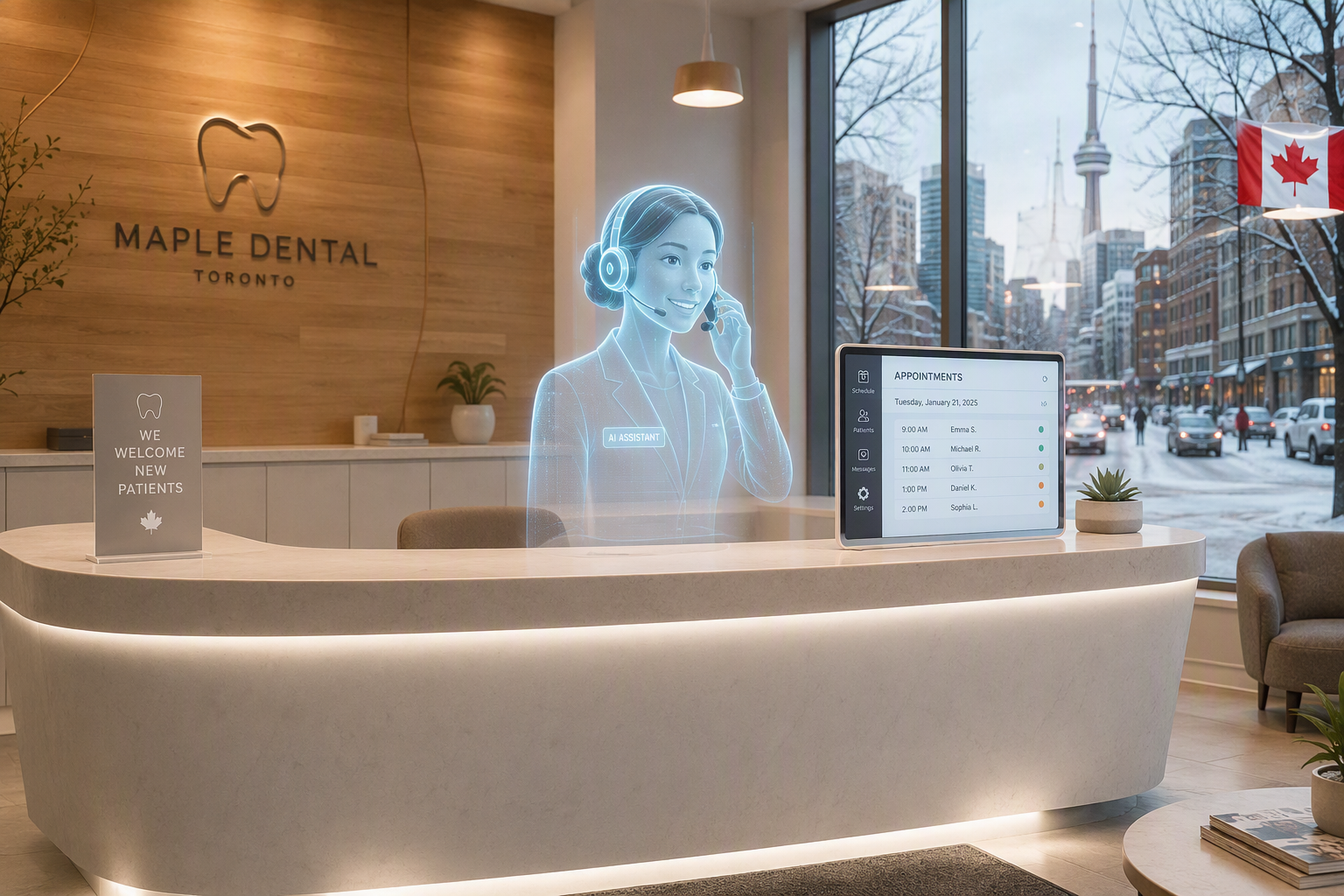
Every Canadian dental clinic loses patients to the same quiet problem: the phone rings while the front desk is at lunch, on another line, or checking in a walk-in. Here is what an AI receptionist changes.
Sarah needs a root canal. She's been putting it off for three weeks, and today — on her lunch break in Mississauga — she finally works up the courage to call the dental clinic her coworker recommended.
The phone rings four times. Then voicemail.
Sarah doesn't leave a message. Almost nobody does. She googles "dentist near me," calls the second result, and books an appointment there in ninety seconds.
That clinic didn't lose Sarah because of bad dentistry, bad reviews, or bad pricing. They lost her because it was 12:40 PM and their front desk was at lunch — the same reason clinics across Canada quietly lose patients every single weekday.
This article is about that gap: what it actually costs, why hiring harder doesn't fix it, and what an AI receptionist does differently.
The lunch-hour problem nobody tracks
Ask most dental clinic owners how many calls they miss and you'll get a guess. "Maybe a couple a week?" The phone system knows the truth, but nobody pulls the report.
Here's what the data typically shows when clinics finally look: 20 to 30 percent of inbound calls go unanswered during business hours. Not after hours — during the day. The reasons are painfully ordinary:
- 12 PM to 1 PM — the front desk takes lunch. Patients call on their lunch breaks. The two overlap perfectly.
- The second line problem — one receptionist, three calls at once. Two of them ring out.
- The walk-in collision — a patient at the counter always wins over the phone. The caller hears ringing, then nothing.
- Monday mornings — a weekend's worth of toothaches all calling between 8 and 10 AM.
Industry estimates put the lifetime value of a new dental patient in Canada between $1,500 and $3,000 — more for families, much more for cosmetic work. A clinic missing just five new-patient calls a month isn't losing appointments. It's losing somewhere between $90,000 and $180,000 a year in patient lifetime value, one unanswered ring at a time.
Why "just hire another receptionist" doesn't solve it
The obvious fix is staffing, and it's worth being honest about why it rarely works.
A full-time receptionist in Toronto or Vancouver costs $40,000 to $50,000 a year, plus benefits, plus training, plus turnover — and dental front desk turnover is notoriously high because the job is genuinely hard. Even then, your second receptionist also takes lunch. Also gets sick. Also can only take one call at a time. You've doubled the cost and solved maybe 60 percent of the problem.
And none of it touches after-hours calls, which is when a surprising share of new patients actually reach out — evenings, weekends, Sunday night when the toothache they've ignored all week becomes unbearable.
What an AI receptionist actually does on a dental call
Forget the robotic phone menus you're picturing. A modern AI voice agent holds a natural conversation. Here's what Sarah's call sounds like when a WeDial AI agent answers:
The agent picks up on the first ring — at 12:40 PM, 8 PM, or 6 AM on a Saturday. It introduces itself, asks how it can help, and listens.
It handles the real questions patients ask. "Do you take my insurance?" "How much is a cleaning without coverage?" "Do you have anything this week?" The agent answers from your clinic's actual information — services, pricing guidance, insurance policies, hours — not generic scripts.
It books the appointment. Connected to your calendar or practice management schedule, it offers real open slots, books Sarah in, and sends her an SMS confirmation before she hangs up. No callback needed, no phone tag.
It escalates what it shouldn't handle. A patient describing severe swelling and fever? The agent flags it as urgent and routes to the on-call contact immediately, exactly per your protocol.
It never has a bad day. No hold music, no rushed tone during Monday chaos, no caller number 4 ringing out while the desk juggles the morning rush.
The human front desk doesn't disappear — it gets to do the job humans are actually good at: warmth at the counter, care coordination, the anxious patient who needs a person. The AI takes the overflow, the lunch hour, and the after-hours shift nobody wanted anyway.
Built for how Canadian clinics actually run
A few things matter specifically in Canada, and they're worth checking with any AI vendor you evaluate:
- PIPEDA and provincial privacy laws. Patient calls involve personal health information. Your AI receptionist must handle data with Canadian privacy compliance in mind — know where call data lives and how it's protected.
- Bilingual callers. In Ottawa, Montreal, and much of New Brunswick, a caller who opens in French should get a natural French conversation — not a confused pause.
- Insurance-heavy conversations. Canadian patients ask about coverage constantly. Your agent needs your real answers on direct billing, the Canadian Dental Care Plan, and common insurer questions.
- Time zones. A national dental group spans six of them. "After hours" is always happening somewhere — which is exactly when an AI agent earns its keep.
The 30-day picture
Here's what clinics typically see in the first month with an AI receptionist on the lines:
1. Zero missed calls — every ring answered, day and night, lunch included.
2. Recovered patients like Sarah — new bookings from calls that previously hit voicemail, usually visible in the schedule within the first week.
3. A calmer front desk — your team stops drowning in the phone and starts doing their best work with the patients in front of them.
4. A real record of every call — transcripts and summaries, so for the first time you actually know why people call and what they ask.
Most clinic owners tell us the strange part is how quickly it becomes normal. By week three, the question shifts from "should we have done this?" to "how did we run the phones before?"
Hear it before you pay a cent
WeDial AI works the way we think every AI company should: you hear your own AI receptionist before you pay anything.
Tell us about your clinic, and we'll set up a live agent with your services, your hours, your insurance answers — then you call it yourself. Talk to it. Try to stump it. If you don't love how it sounds, you walk away having spent nothing.
👉 Get free demo credits and hear your agent today: [wedialai.com/demo-credits](https://wedialai.com/demo-credits)
💬 Prefer to talk to a human first? Message our team on WhatsApp: +254 774 509 764
🦷 Ready to stop losing the lunch-hour callers? Start your free trial at [wedialai.com](https://wedialai.com)
Sarah is calling someone this week. The only question is whether someone — or something — picks up.
One practical AI tip for your business, every week
The WeDial Weekly — every Sunday morning. No spam, unsubscribe anytime.
Never miss another customer call
See how WeDial AI answers, qualifies, and books for your business — 24/7, in English and Swahili.
Get Free Demo CreditsRelated articles
AI for SACCOs in Kenya: Member Inquiries, Loan Questions and Payment Reminders on Autopilot
Kenyan SACCOs run on member trust — and on phone calls. What happens when an AI receptionist answers every "niaje, naeza check my loan…
AI Voice Agents Now Answer Calls at Virgin Media O2
AI voice agents went mainstream: Virgin Media O2 now answers customer calls with AI and McDonald's takes bilingual drive-thru orders. What…
Vapi vs Retell vs Custom Builds: An Honest Guide to AI Voice Stacks
Every business adopting AI voice agents faces the same fork in the road: a voice-orchestration platform like Vapi, an end-to-end product…