The AI Playbook for Safari Companies and Tour Operators in Kenya: Answer Every Dream-Trip Call, Quote Before Competitors Wake Up, and Book the Mara at 5 AM
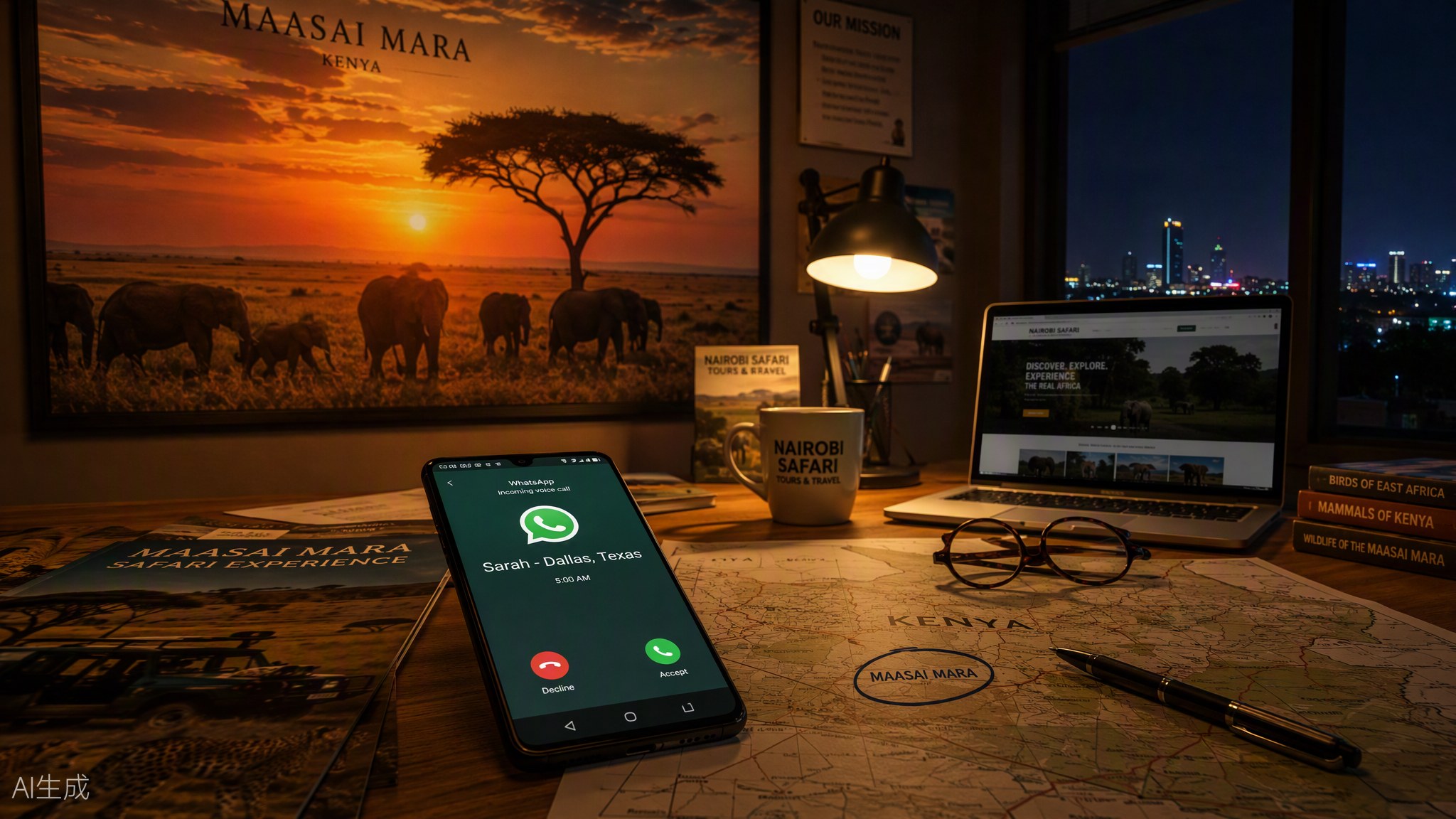
Kenya's safari companies lose bookings worth KES 1 million+ to the time-zone gap — the client in Dallas calls at 5 AM Nairobi time. Here's how an AI receptionist answers every dream-trip inquiry, in English and Kiswahili, 24/7.
It's 9:14 PM in Dallas, Texas. A couple has just finished watching a documentary about the Great Migration, and they're decided: this is the year. The Maasai Mara, honeymoon, ten days. They've found four Kenyan safari companies on Google, and they're reaching out to all four right now — calls, WhatsApp, inquiry forms.
In Nairobi, it's 5:14 AM. Every office is dark. Every phone is on a silent desk. Every "we'll get back to you" auto-reply is doing what auto-replies do: nothing.
Except one. The fourth company has an AI receptionist. It answers the call on the second ring, in perfect English. It captures their dates, their budget, their dream — lions, a balloon safari, a tented camp. It answers their questions about the migration season and yellow-fever requirements. It books them a video call with a safari consultant for 6 PM Dallas time — and before the couple goes to bed, a WhatsApp message lands with a sample itinerary and the company's brochure.
By the time the other three companies open their offices at 8 AM, the deal is emotionally done. A KES 850,000 honeymoon safari went to the company that answered at dawn. The rest never knew the call happened.
The Time-Zone Trap Every Safari Company Lives In
Tourism is Kenya's most beautiful industry and its most brutal sales environment, for one simple reason: your customers are awake when you're asleep.
Your buyers sit in Texas, London, Dubai, Frankfurt and Sydney. The American family plans their trip between 6 PM and 10 PM their time — which is 1 AM to 5 AM Kenyan time. The British couple browses after dinner — 9 PM to midnight in Nairobi. The Dubai executive plans his December getaway after iftar. Every single day, the highest-value inquiries in Kenyan tourism arrive in the hours when no human being is in your office.
And in travel, the first-responder rule is merciless. Studies of travel and hospitality sales consistently show that the company which responds first wins the booking the overwhelming majority of the time — because a safari isn't a product, it's a dream, and whoever engages the dream first owns it. A traveler who gets a warm, detailed response in five minutes stops shopping. A traveler who waits eight hours keeps calling your competitors.
Small businesses miss 20% to 35% of their calls during working hours. After-hours, the number is 100%. For a safari company, those after-hours calls are not the overflow — they ARE the market.
Want to see this working on your own business? Get a free AI demo call at https://wedialai.com/demo-credits — it takes two minutes and costs nothing.
What One Missed Safari Inquiry Actually Costs
This is not a KES 15,000 brake job. Look at what's actually at stake when the phone rings out at 3 AM:
- Amboseli or Nakuru day/overnight trip for two: KES 45,000 to KES 120,000
- 3-day Maasai Mara package: KES 90,000 to KES 250,000 per person
- 7–10 day Kenya-Tanzania circuit or honeymoon safari: KES 400,000 to KES 1,500,000+
- Luxury tented-camp and fly-in safaris: KES 2 million and beyond
- Corporate retreats, school trips, church groups: 20 to 60 seats at once
Then multiply by what safari clients do next: they leave the Google and TripAdvisor reviews that feed your next ten bookings, and they refer their friends — honeymooners tell engaged couples, and engaged couples are next year's clients. One answered 3 AM call can realistically be worth KES 1 million in direct revenue and several million in the referral chain it starts.
Miss just four serious inquiries a month at a conservative average of KES 300,000 — that's KES 1.2 million in monthly revenue gone, KES 14 million a year, not lost to a better itinerary or a better price. Lost to a ringing phone in a dark office.
What an AI Receptionist Does for a Tour Operator
Let's be precise about the division of labor: your consultants design dream trips. The AI makes sure dream clients reach your consultants. Here's what it handles, at 3 PM or 3 AM:
- Answers every call and WhatsApp inquiry instantly, 24/7, in natural English — with Kiswahili for your domestic and regional clients
- Conducts a proper safari intake: travel dates, group size, ages of children, budget range, must-see parks, accommodation style, dietary needs — the full brief before your consultant even wakes up
- Answers the questions every first-time safari client asks: When is the migration? Do we need yellow-fever certificates? What about visas? Is Kenya safe for families? What should we pack?
- Sends instant WhatsApp follow-ups with your brochure, sample itineraries, and a consultation booking link set to the CLIENT'S time zone
- Follows up on quotes automatically — the quote you sent Tuesday that went quiet gets a polite, perfectly-timed nudge on Friday, because most safari quotes don't die from a "no"; they die from silence
- Captures every inquiry into a log you can actually review: who called, from where, about what, and what happened next
A Week in the Life: Before and After
Before: A mid-sized operator in Nairobi with excellent guides and 4.9 stars on Google. Monday night, three inquiries from the US come in between 11 PM and 4 AM — answered Tuesday at 9 AM, thirteen hours later. One has already booked with a competitor who responded in ten minutes. Wednesday, a quote worth KES 620,000 goes to a couple in Manchester; nobody follows up; it dies silently. Friday, a Dubai family of six calls during Ramadan evening hours — rings out. The week's invisible loss: two bookings, roughly KES 900,000.
After: Same company, same guides, same week. The three night inquiries are intaken instantly, get itineraries on WhatsApp within minutes, and all three book video consultations. The Manchester quote gets an automated Friday nudge: "Still planning? Migration season dates are filling" — they reply within the hour and pay a deposit Monday. The Dubai family books a 6 PM Gulf-time call and converts the same week.
Nothing about the safaris changed. The company simply stopped being asleep while its customers were awake.
"Safari Is a High-Touch Business — Can AI Really Handle It?"
Every tour operator says this, and they're half right: safari IS high-touch. That's exactly why the human hours you have should go to designing itineraries and closing dream trips — not to losing clients in a first-response race you physically cannot run at 3 AM.
Understand what travelers actually punish: not talking to AI, but waiting. A caller who gets an immediate, warm, knowledgeable response — dates captured, questions answered, consultant call booked for their evening — feels served, not processed. Compare that to ringing phones, a WhatsApp blue-ticked for two days, or an email answered after they've already paid a deposit elsewhere.
The handoff is seamless: the AI captures the dream, your consultant designs it. The client meets a fully-briefed human who already knows their dates, budget, and that their daughter wants to see a cheetah. That first consultation feels like magic — and magic closes safaris.
The Numbers: AI vs a Night-Shift Sales Agent
You could staff your way out of this: hire night-shift sales agents to cover US and Gulf hours. A competent travel sales agent in Nairobi costs KES 40,000 to KES 80,000 a month — and to cover the time zones properly you'd need at least two on rotation, plus weekend cover, plus sick-leave cover. You're near KES 200,000 a month before you've answered a single extra call, and human agents still miss calls when two come in at once.
An AI receptionist from WeDial AI costs a fraction of that, answers unlimited simultaneous inquiries, never sleeps through a Dallas evening, speaks to your clients naturally, follows up on every quote, and scales from ten inquiries a night to a hundred without a single extra shilling. In a business where one booking can be worth KES 1 million, the maths isn't close.
Getting Started: Your First Two Weeks
No new systems, no disruption to your operation:
- Day 1: You give us your packages, price ranges, parks, seasons, and the questions your clients always ask.
- Days 2–3: We configure your AI receptionist — your company's voice, intake questions, itinerary library, WhatsApp follow-ups, and your consultants' calendars across time zones.
- Day 4: Every call and inquiry gets answered instantly — day, night, weekend, holiday.
- Week 2: You review your inquiry log and see exactly what was slipping through while Nairobi slept. Most owners tell us the same thing: they had no idea the demand was this big.
Somewhere in Texas tonight, a couple is finishing a documentary about the Great Migration. They will reach out to four Kenyan safari companies before they sleep.
Be the one that answers. Book your free demo at wedialai.com — and hear exactly what your next KES 850,000 client will hear when they call at 5 AM.
Hear It for Yourself — Free
Reading about an AI receptionist is one thing. Hearing one answer a real call is what convinces business owners. That is why WeDial AI lets you try it free: tell us your business type, and our AI agent will call your own phone within minutes — answering questions, booking a sample appointment, and showing you exactly what your customers will experience.
- Get your free demo call now at https://wedialai.com/demo-credits
- See plans and pricing — starting at $49/month — at https://wedialai.com
- Prefer to talk first? Reach our team via https://wedialai.com/contact or WhatsApp +254 774 509 764
Every day without an answer is revenue walking to a competitor. Hear your future receptionist today — and never miss another customer.
One practical AI tip for your business, every week
The WeDial Weekly — every Sunday morning. No spam, unsubscribe anytime.
About the author
Peter Wafula is the founder of WeDial AI — a Nairobi-built platform of AI voice and chat agents that answer every call for businesses in 52 languages. He writes from hands-on experience deploying AI agents for real businesses.
Never miss another customer call
See how WeDial AI answers, qualifies, and books for your business — 24/7, in English and Swahili.
Get Free Demo CreditsRelated articles
The WeDial Wallet: Transparent, Pay-As-You-Grow AI Pricing
Most AI vendors hide their pricing. WeDial AI publishes it: three monthly minute wallets from $49, a flat $0.176/min domestic overage and…
This Week in AI Voice: 5 Stories That Mattered (Oct 5–11, 2026)
ElevenLabs at $22B, agents that chase unpaid invoices, India's voice-to-WhatsApp playbook and the UK's non-compete ban — the week in AI…
This Week in AI Voice: 5 Stories That Mattered (Sep 28–Oct 4)
Microsoft's real-time voice model, OpenAI's always-on dots agents, the FTC's AI-agent probe, Gemini Skills and a $350M raise — this week…